
98th Academy Awards Post-Mortem
My thoughts on the Oscar ceremony and its aftermath ranging from the winners to Ballet-gate.

We reached the end of what was an admittedly stressful overlong Oscar season. Although it was stressful in good ways as there were some categories with genuine suspense as to who was going to prevail, this season still proves that the Oscars must remain at the end of February to prevent an extension of ugly online discourse.
But for this post, we’re going to mainly focus on the ceremony and its aftermath.
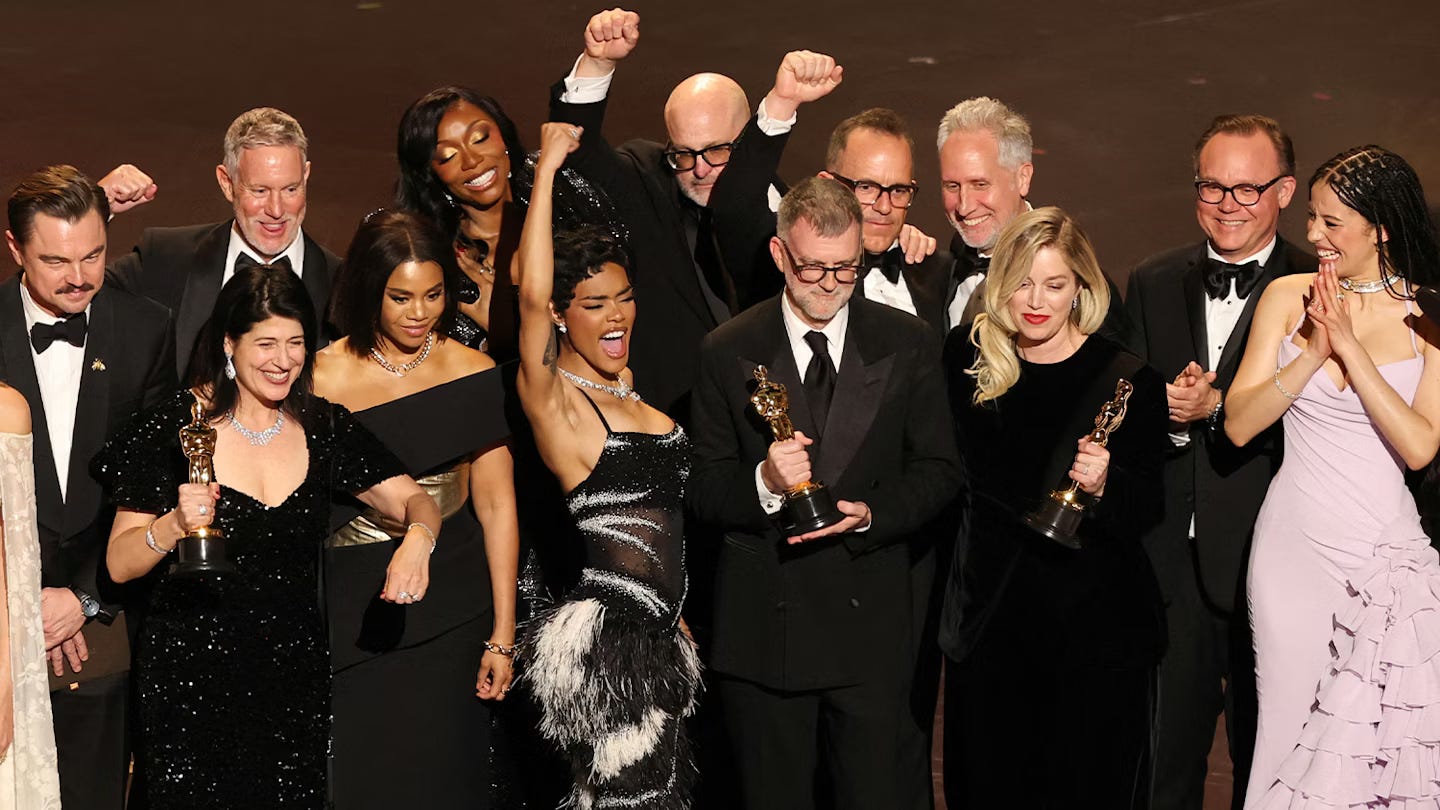
The cast and crew of Best Picture winner “One Battle After Another” at the 98th Academy Awards.
As we all expected, Paul Thomas Anderson’s latest film won one Oscar after another. Along with the three awards Anderson won for Best Picture, Best Director, and Best Adapted Screenplay, it took home Best Supporting Actor for an absent Sean Penn, Best Film Editing for Andy Jurgensen, and, in a slight shocker, the inaugural Oscar for Best Casting. Going into the ceremony, Francine Maisler was expected to win the prize for Sinners only for Cassandra Kulukundis to win and foreshadow the night that One Battle After Another would have.
Speaking of Sinners. Oh, the horror! The amazing horror!
Sinners became the second biggest winner of the night behind One Battle After Another with four in Best Actor for Michael B. Jordan, Best Original Screenplay for writer/director Ryan Coogler, Best Original Score for Ludwig Göransson, and in what was the best shocker of the night, Best Cinematography for Autumn Durald Arkapaw. Thanks to her victory, Arkapaw is not only the first woman but the first woman of color to win this category. Sinners also won big in what was a banner night for the horror genre thanks to Guillermo del Toro’s Frankenstein winning three craft prizes: Best Costume Design, Best Production Design, and Best Makeup & Hairstyling, and Amy Madigan winning Best Supporting Actress for Weapons.
That being said, that last win is what’s led to some heated debate I’ve noticed online.
Given how Amy Madigan is a veteran actress, people have been quick to dismiss her victory as a career win which I disagree with. While Madigan is a veteran and her nomination for Weapons was her first in 40 years, the nomination gap was really the only narrative she had going into the ceremony. Despite having a steady, decades-long career, Madigan didn’t go in with the same kind of “revered unrewarded veteran getting their due” narrative that Gary Oldman had with Darkest Hour. Also, while she’s been in acclaimed films like Best Picture nominee Field of Dreams and Gone Baby Gone, her win didn’t feel like the culmination of years of iconic work that Jamie Lee Curtis’ win for Everything Everywhere All At Once mostly felt like.
The fact that Madigan didn’t have a narrative beyond the nomination gap and won even with hurdles stacked against her, like the BAFTA snub and her being the only nomination for her film, proves that this win felt mainly like a case of quality over politics. Furthermore, thanks to her role as Aunt Gladys, Amy Madigan is arguably more famous than she’s ever been. That alone is something worth celebrating.
Then there’s the Marty Supreme of it all. Despite having nine bids, the A24 ping pong dramedy went home empty-handed. Timothée Chalamet losing Best Actor, in particular, has caused an ongoing stir. For starters, no. It wasn’t Ballet-gate that cost him the Oscar as the clip of his comments didn’t go viral until the end of Oscar voting. But there were other factors at play.
Given how Chalamet was the best chance at Marty Supreme winning anything, the film was clearly in a case where it was admired more than loved whereas Sinners, which won four trophies and earned more nominations, was more beloved hence Jordan winning over Chalamet. Also, while Ballet-gate didn’t cost him the gold, it still felt like a tipping point of Chalamet overexposure. Chalamet not only being omnipresent but being too unfiltered on the Marty Supreme press tour proved to be off-putting for viewers and apparently, Academy voters as well.
Do I think his loss or his ego will make a huge dent in his career? Probably not. He’s still got Dune: Part Three coming out later this year which’ll likely be a money maker. Also, because he’s still 30 years old, one could look at his loss at voters trying to humble him. So, unless he keeps burning bridges, a win may come down the line. But no matter what the context of his ballet and opera comments are and regardless of the fact that the film’s press tour did wonders for its box office, Timothée Chalamet may still need to at least take a break from the public eye until Dune: Part Three comes out.
Now that we’ve got that out of the way, onto the ceremony.
First off, the “In Memoriam” segment was the best it’s been in who knows how long. Although there were still some glaring omissions, the way they kept as many names as they could and honored greats like Rob Reiner, Diane Keaton, Catherine O’Hara, and Robert Redford made it as poignant as it should be.
Then there’s Conan O’Brien as the host. Like last year, he nailed his monologue and admirably pulled no punches when it comes to getting political. Furthermore, compared to last year which felt a tad quieter in terms of presenters and winners addressing our current political climate, thankfully, that wasn’t entirely the case here.
From Jimmy Kimmel calling out CBS to Javier Bardem saying “No to war and free Palestine!” to Joachim Trier who accepted Best International Feature on behalf of Norway for Sentimental Value and held politicians who neglect the needs of children accountable in his acceptance speech, this ceremony proved that while the Oscars are a time of celebration, what’s happening in the real world shouldn’t be brushed aside. It bears repeating but cinema is inherently political.
May we continue to spread that message all-year round and not just during festival and awards season.
Onward…..